
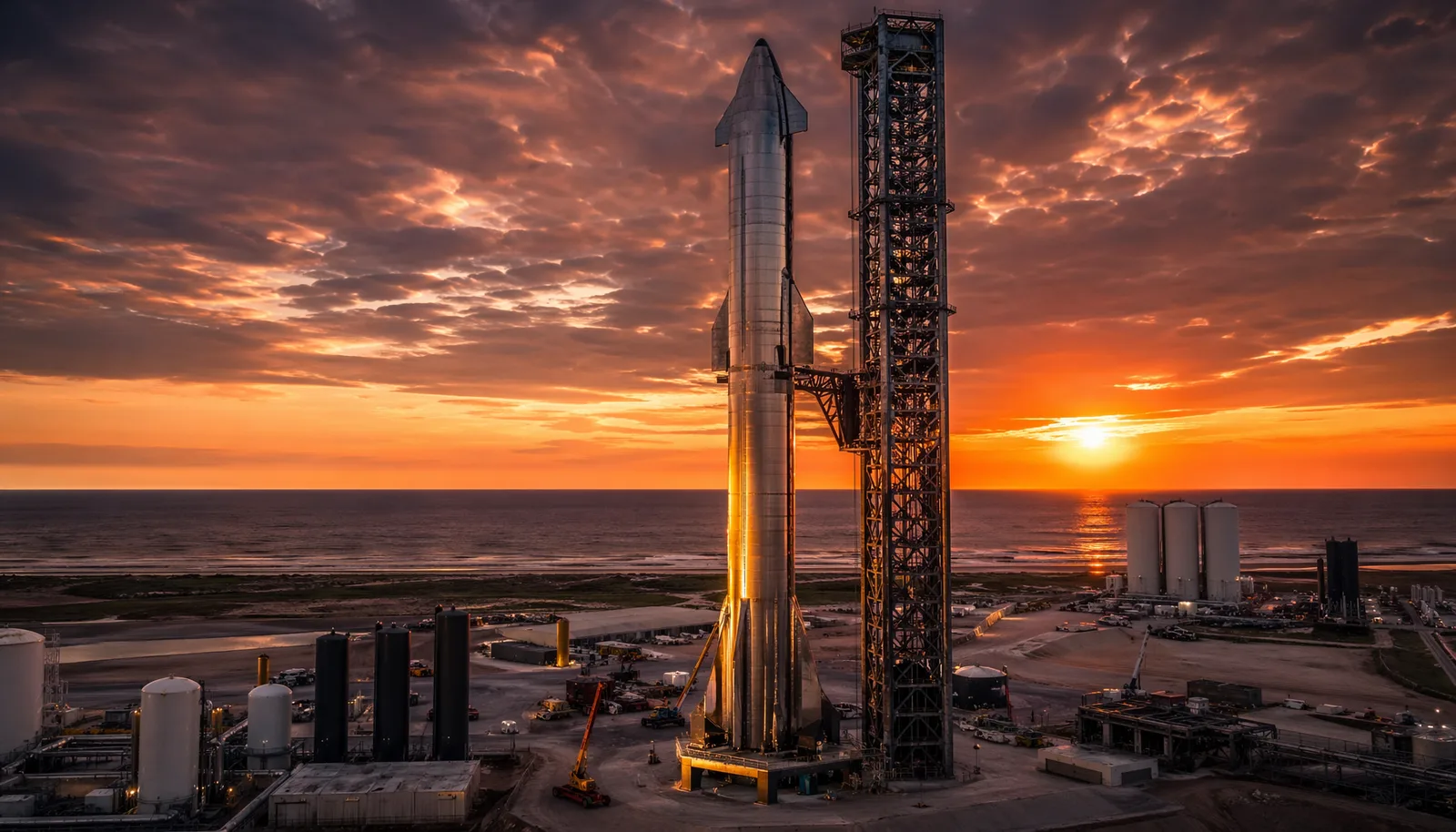
The SpaceX S-1 Is a Blueprint for a Civilization-Scale Company
The largest IPO in history just showed its cards. The valuation is not pricing a rocket company. It is pricing orbital infrastructure.
SpaceX's now-public S-1 reveals $18.67B in revenue, a $1.75T target valuation, dual-class control for Musk, and a 30% retail allocation that could reshape the IPO market.
The SpaceX S-1 just dropped. And it reads like a funding document for a civilization.
SpaceX filed its confidential draft registration statement with the SEC on April 1, 2026. The prospectus is now public. The numbers, the governance structure, and the sheer audacity of the raise are all on the table. This is not a normal IPO. This is a capital markets event that bends the curve of what "going public" means.
Here is what the filing says, what it means, and why the consensus is probably still thinking too small.
What Happened
SpaceX is targeting a June 2026 Nasdaq listing at a valuation of roughly $1.75 trillion, with plans to raise up to $75 billion. If completed, this would be the largest initial public offering in history, more than 2.5 times the $29.4 billion Saudi Aramco raised in 2019.
The prospectus reveals a dual-class share structure. Class B shares carry 10 votes each and stay with Musk and a small circle of insiders. Class A shares, sold to public investors, carry one vote each. Musk holds approximately 42% of equity but controls roughly 79% of the votes.
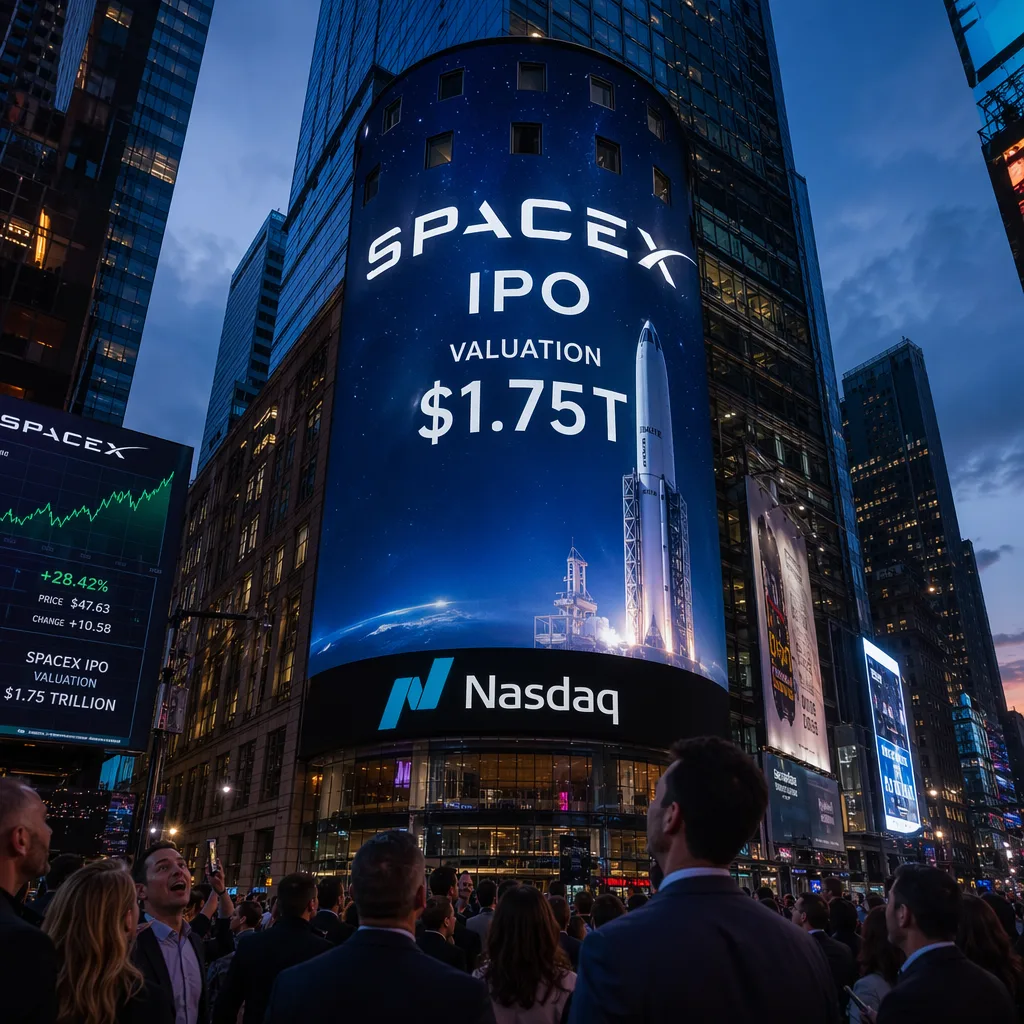
The filing also shows the financial shape of the merged entity. SpaceX acquired xAI in February 2026 in an all-stock transaction. The combined company reported $18.67 billion in revenue for 2025, but swung to a $4.94 billion consolidated loss, driven by heavy xAI infrastructure spending. In 2024, SpaceX alone posted a $791 million profit on $14.02 billion in revenue.
Starlink remains the profit engine: 9.2 million subscribers, over $10 billion in revenue, and billions in operating profit. The satellite internet business is carrying the weight of xAI's losses and still keeping the balance sheet healthy. SpaceX ended 2025 with $24.8 billion in cash, $92 billion in total assets, and $50.8 billion in liabilities.
Bank of America, Goldman Sachs, JPMorgan Chase, and Morgan Stanley are acting as senior underwriters. And there is an unusual retail component: up to 30% of shares allocated to individual investors, roughly three times the norm for a large IPO.
This week, SpaceX is hosting three days of analyst meetings at Starbase in Boca Chica, Texas, including facility tours and executive briefings. Gwynne Shotwell received $85.8 million in total compensation last year. Musk's official salary: $54,080. His real payday comes in equity after the listing.
Why It Matters
This is the first time public investors get to see inside SpaceX's financials. And the picture is not simple.
The revenue multiple at $1.75 trillion on $18.67 billion in revenue is roughly 94x. That is not a value play. That is a bet on the next decade: Starship as a platform, Starlink as orbital infrastructure, and the xAI merger creating something that looks like a vertically integrated compute-and-connectivity company that also happens to build the most powerful rocket ever flown.
The 30% retail allocation is significant. Most large IPOs give retail investors scraps. SpaceX is opening the door wider, which could create massive demand pressure from individual investors who have waited years for access.
The dual-class structure is standard for founder-led tech companies (Meta, Alphabet, Snap all use versions of it), but the ratio here is extreme. Public shareholders get economic exposure. They do not get a seat at the table.
The Consensus Take
Wall Street sees a generational IPO. The underwriter lineup is the full A-team. Analyst Day at Starbase is designed to convert skeptics into believers. The consensus narrative: Starlink prints cash, Starship is the future, and the xAI merger adds an AI layer that justifies the multiple.
The critics have a point too. Former Fidelity fund manager George Noble called the dual-class structure "the most SHAMELESS structural manipulation of a major index," arguing that retail investors are being positioned as exit liquidity for early insiders who bought at much lower prices.
The Mr. X Take
The critics are reading the governance docs. They are not reading the launch manifest.
SpaceX is approaching its 600th Falcon landing. Starship is flying. Starlink covers 9.2 million subscribers and growing. The xAI merger, for all the accounting noise it creates, gives SpaceX something no other launch company has: an AI research lab, a social media platform, and a reason to build data centers in orbit.
The $1.75 trillion number sounds insane until you do the math on what Starlink alone could be worth at 50 million subscribers with enterprise pricing, government contracts, and aviation deals layered on top. Add Starship's economics (lower cost per kilogram to orbit than anything in history) and the optionality of point-to-point transport, lunar logistics, and Mars cargo. The valuation is not pricing the present. It is pricing the infrastructure layer of the next century.
Is 94x revenue expensive? Yes. Is it expensive for the company that owns the orbital transport monopoly, the largest satellite constellation in history, and is now merging with an AI lab? That is a different question.
The Engineering Layer
The S-1 does not just show financials. It shows what SpaceX actually is under the hood.
Starlink's operating income surged enough to offset xAI's widening losses. That means the satellite business is not just revenue-positive, it is profit-positive at scale, throwing off enough cash to subsidize an entirely separate AI infrastructure buildout. That is factory physics applied to orbital connectivity.
Starship, while not broken out in detail, represents the next cost curve. Every improvement in payload capacity and reusability drives down the marginal cost of everything SpaceX does: Starlink deployment, government contracts, commercial launch, and eventually cargo to Mars. The S-1 hints at "Orbital AI Data Centers," combining satellite connectivity with edge computing. If that sounds like science fiction, remember that Starlink was science fiction five years ago.
The Market Layer
The $75 billion raise is not just large. It changes the IPO market itself.
If SpaceX prices at $1.75 trillion, it enters the public markets as one of the ten most valuable companies on Earth on day one. The 30% retail allocation means billions in shares available to individual investors, something almost unheard of at this scale. This could trigger a demand wave that makes the first few trading days volatile and spectacular.
The entire market watching retail investors discover they can finally buy SpaceX.
The dual-class structure means Musk keeps control regardless of how many shares trade publicly. For investors who want exposure to the SpaceX growth story, that is the deal: you get the economics, he keeps the steering wheel. History suggests founder control works well when the founder is executing (see Bezos, Zuckerberg). It works badly when they are not. Musk's execution record at SpaceX is, by any measure, extraordinary.
The underwriter lineup (BofA, Goldman, JPMorgan, Morgan Stanley) signals institutional confidence. These banks do not attach their names to offerings they think will stumble.
The Meme Layer
The internet has been waiting for this moment for years. SpaceX going public is not just a financial event. It is a cultural one.
Every retail investor who watched Falcon landings on YouTube, every Starlink beta tester in rural Montana, every space nerd who followed Starship tests from Boca Chica beach, they all want in. The 30% retail allocation is SpaceX acknowledging that its shareholder base is not just institutions. It is a community.
The ticker symbol speculation ($X, $SPACEX, $SPCX) is already a meme format. The dual-class share discourse is producing galaxy-brain takes. And the idea that you can buy a piece of the company that is literally building the road to Mars? That is the kind of narrative that moves markets independent of fundamentals.
Risks
They are real, and the S-1 makes them visible.
The xAI drag. The merger turned a profitable company into one posting a $4.94 billion loss. xAI's infrastructure spending is heavy and ongoing. If xAI does not generate meaningful revenue soon, the combined entity's losses will weigh on the stock.
Valuation altitude. 94x revenue is not a margin of safety. It is a margin of faith. If Starlink subscriber growth slows, if Starship development hits delays, or if the AI data center vision does not materialize, the multiple compresses fast.
Governance risk. Public shareholders have no real power. If Musk makes a decision the market hates (and he has before), there is no mechanism to override it. You are betting on the operator, not the board.
Regulatory and geopolitical. SpaceX operates in heavily regulated airspace and spectrum. FAA licensing, FCC spectrum fights, international regulatory frameworks, and the geopolitical sensitivity of a global satellite network all create risk that is hard to model.
Concentration. SpaceX is Musk. If something happens to Musk, or if his attention fractures further across too many companies, SpaceX's execution advantage could narrow.
Bottom Line
The SpaceX S-1 is not just a prospectus. It is the first public blueprint for what might become the most valuable company on Earth.
The financials show a company with a profit engine (Starlink), a platform under construction (Starship), an AI bet (xAI), and a founder who controls the whole thing with an iron grip. The valuation demands you believe in the next decade, not the last quarter. The governance demands you trust the builder.
For those who have watched SpaceX catch a rocket booster with chopsticks and thought "this company should be public," the wait is almost over. June is two months away. The S-1 is live. The road to the Nasdaq runs through Boca Chica.
This is commentary, not financial advice. Verify primary sources and official filings before making investment decisions.
Mr. X is an ultra-concentrated futurist investor obsessed with Tesla and the broader mission-driven technology ecosystem. He believes the market consistently underestimates the pace of disruptive innovation and is willing to withstand extreme volatility for asymmetric upside. He tracks product roadmaps, manufacturing ramps, and regulatory catalysts with obsessive detail.
View all articles →