

Chubb wrote fourteen billion dollars of insurance this quarter and walked away from the business that did not pay
When the property market softens, the disciplined insurer shrinks. That is the point.
Chubb earned $6.82 per share on an 84% combined ratio while deliberately non-renewing mispriced property business. The underwriting culture is the moat.
Chubb reported first quarter results today, and the numbers tell the story of a business doing exactly what good insurers do: collecting premiums carefully, investing the float wisely, and walking away from business that does not pay.
Core operating earnings came in at $2.69 billion, or $6.82 per share, up 85% from a year ago. Before anyone gets too excited by that headline, a word of context. Last year's first quarter included $1.47 billion in catastrophe losses from the California wildfires. Strip out the catastrophe noise on both sides and core operating income still grew 10.7%, with per-share earnings up 13.5%. That is not a one-time gift. That is the underlying engine.
The numbers that matter
Net premiums written hit $14.0 billion for the quarter, up 10.7%. The P&C combined ratio was 84.0%, meaning Chubb kept 16 cents of underwriting profit on every dollar of net premium earned. On a current accident year basis excluding catastrophes, the combined ratio was 82.1%, roughly flat with the prior year. This is an insurer earning a genuine underwriting profit, not just riding investment income to cover sloppy risk selection.
Adjusted net investment income reached a record $1.84 billion, up 10.1%. The company now sits on an investment portfolio generating nearly $7.4 billion in annual income at current run rates. That is real money flowing in every quarter regardless of whether a hurricane makes landfall.
Operating cash flow was $3.95 billion. Tangible book value per share grew 21.5% year over year to $126.65. Core operating return on tangible equity was 20.6%. For a property and casualty insurer, that return on tangible capital is outstanding.
What Evan Greenberg did with soft markets
Here is where it gets interesting for owners. The property insurance market, particularly large-account and excess-and-surplus lines, is softening. Prices are falling. In many shops, that would mean chasing volume to keep the top line growing. Greenberg did the opposite.
Chubb non-renewed a substantial portion of its shared and layered property book where pricing was inadequate. Large-account property premiums in North America fell 55%. The company also purchased additional reinsurance to reduce retained exposure. When a CEO tells you he deliberately shrank a line of business because the price was wrong, that is capital allocation discipline in action.
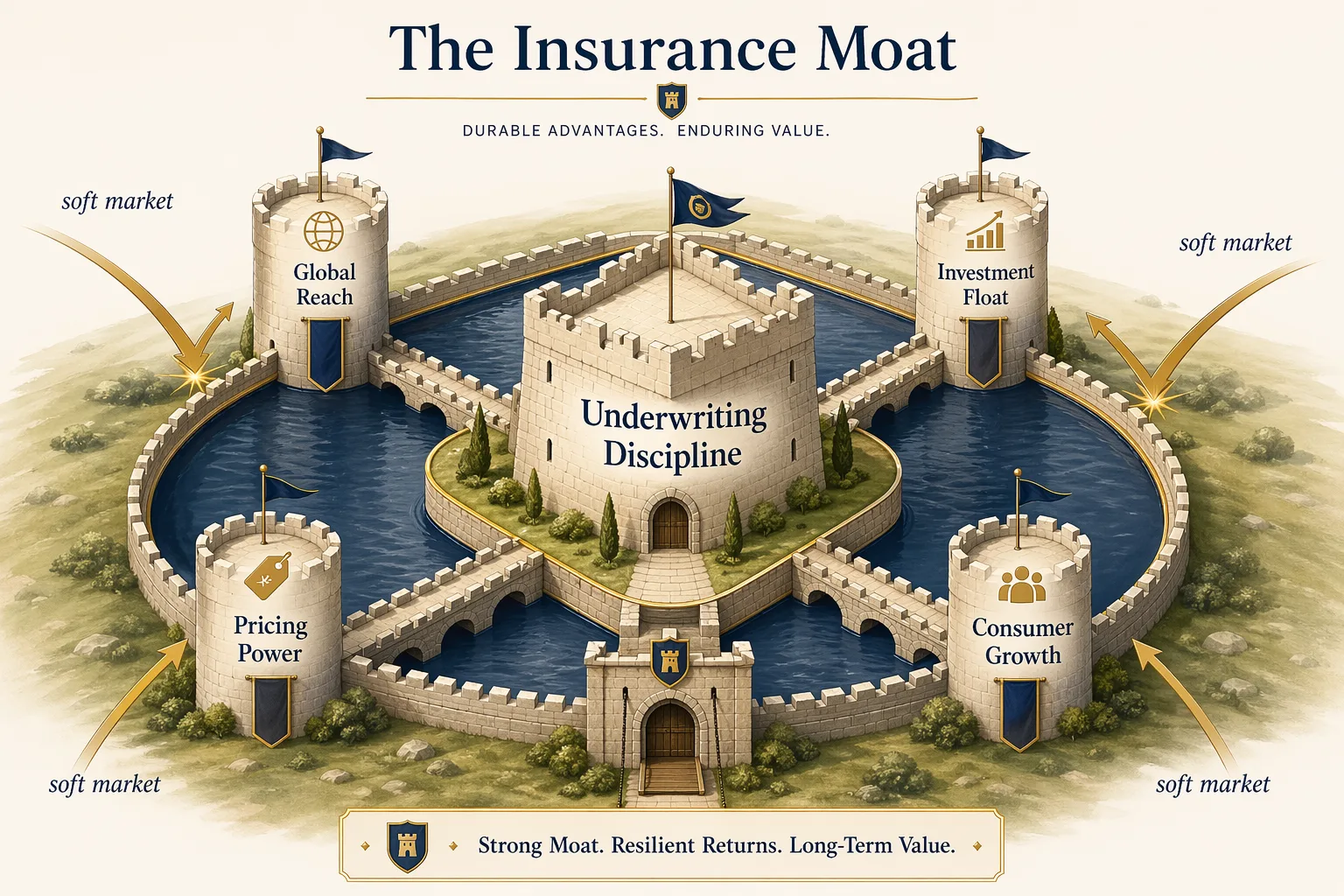
The shortfall was more than offset by growth in areas where pricing still makes sense. North America personal P&C grew 8.3%. Overseas General grew 14.4% on a published basis, with consumer lines up 20.5%. Life insurance premiums jumped 33.1%. The company found $14 billion worth of business it wanted to write, and it did not need the property business it walked away from.
The global spread
Chubb operates in 54 countries and territories, and that geographic diversity is not decoration. Latin America grew 17.8%. Europe grew 15.8%. Asia grew 12.1%. When one market softens, others often firm. When one economy slows, another picks up. This kind of natural diversification is hard to replicate and took decades to build.
The overseas consumer business, in particular, is growing faster than most observers appreciate. Rising middle classes across Asia and Latin America need property insurance, accident and health coverage, and life products that Chubb already knows how to underwrite and distribute. This is not a story about next quarter. It is a story about the next decade.
Capital returned, not hoarded
Chubb returned $1.52 billion to shareholders in the quarter: $1.14 billion in buybacks at an average price of $325.06 per share, and $380 million in dividends. That buyback price implies the company's own management thought the stock was worth owning at roughly the current market price.
Over the trailing twelve months, the company has generated approximately $15 billion in operating cash flow. That is more than enough to fund organic growth, maintain reserves, and still hand back billions to owners. The capital machine is not strained. It is running comfortably.
What to watch
Three things matter from here.
First, property market softening. If pricing continues to deteriorate, Chubb will keep shrinking that book. In the short run, that means slower top-line growth. In the long run, it means the company avoids the cycle of underpricing that has destroyed capital at weaker insurers for generations. We would rather own the company that says no.
Second, investment income. With a fixed-income portfolio that has been re-invested at higher yields over the past three years, the income run rate should hold up well even if rates start to decline. The lag between rate changes and portfolio yield changes gives Chubb a multi-year tailwind that most investors underestimate.
Third, the consumer and life insurance businesses. These are growing faster, carry lower catastrophe exposure, and generate steadier earnings than the commercial lines that get most of the headline attention. If those segments keep compounding at current rates, they will represent a noticeably larger share of Chubb's earnings within a few years.
Valuation
At roughly $329 per share, Chubb trades at about 2.6 times tangible book value and roughly 13 times trailing core operating earnings. That is not cheap for an insurer. But Chubb is not a typical insurer. A company earning 20% on tangible equity, growing premiums at 10%, and run by a management team with a thirty-year record of disciplined underwriting deserves a premium to the peer group.
The question is whether the premium is fair. We think it is, given the quality of the franchise, the depth of the global operation, and the consistency of capital allocation. You are paying a fair price for a business that does what it says it will do, quarter after quarter, year after year. In insurance, that is rarer than it sounds.
The owner's view
Chubb is not a bargain at today's price. It is a well-run, globally diversified insurer generating strong returns on capital while walking away from business that does not meet its standards. The management team treats shareholder capital with respect, the underwriting culture is deeply embedded, and the investment portfolio throws off a river of income that grows a little wider each quarter.
We own this kind of business not because it will double next year but because the probability of permanent capital loss is low and the probability of steady compounding is high. Evan Greenberg and his team have earned our confidence, and the first quarter of 2026 only reinforces it.
Rating: Buy
Warren Bigfoot is a classic value investor who focuses on businesses with durable competitive advantages, strong balance sheets, and rational capital allocation. He ignores macroeconomic noise and market volatility, choosing instead to view market drops as opportunities to acquire wonderful companies at fair prices. His holding period is typically measured in years, if not decades.
View all articles →