

Costco barely makes money selling things, and that is the point
Costco earns its real profit from 130 million membership cards, not from groceries. The business is outstanding, but at 55 times earnings the stock is priced for a decade of perfection.
The membership card as a business model
Costco sells $275 billion worth of goods a year and barely makes money on any of it. The grocery margins are thin. The electronics margins are thinner. The gasoline is practically a loss leader.
The real business is the membership card.
Last year, 130 million cardholders paid Costco $5.3 billion in membership fees. That money arrives before a single rotisserie chicken crosses the scanner. And 92.2% of U.S. and Canadian members renew every year, a rate that has held steady for over a decade. That tells you something about how members think about the relationship: they do not view the fee as a cost. They view it as a ticket to savings.
The numbers behind the warehouse
In fiscal Q2 2025, Costco reported $62.5 billion in net sales, up 9.1% from the year before. Comparable-store sales, adjusted for gas prices and currency, grew 9.1%. E-commerce grew 20.9%. These are not the growth rates of a mature retailer running out of ideas. They are the growth rates of a company still adding members and still finding new ways to sell to them.
Operating margin sits at 3.77%. That sounds low, and it is. By design. Costco does not try to maximize the markup on any given item. It caps most margins around 14% to 15% and earns the real profit from membership fees. This keeps prices low enough that members keep renewing, and the cycle continues.
For the trailing twelve months, revenue is about $286 billion. Net income runs around $8 billion a year, or roughly $18.21 per share. The business generates cash reliably, but you will not find Costco on any list of high-margin companies. The margin is thin because the model depends on it being thin.
Why the model works
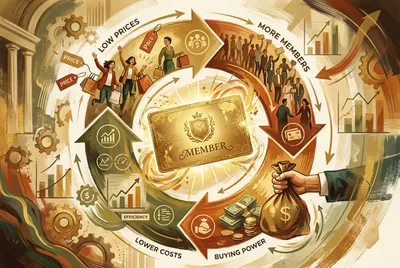
The genius of Costco is that it turns the usual retail incentive on its head. Most retailers try to make more money per item. Costco tries to make less. Every dollar saved on a product is a dollar that reinforces the value of the membership, which is where the real money comes from.
This creates a flywheel. Low prices attract members. More members mean more buying power. More buying power means lower costs from suppliers. Lower costs mean lower prices. The loop tightens over time, and it is hard for competitors to replicate because they have to give up margin to compete, and their business models cannot absorb that.
Walmart can match Costco on some prices. Amazon can beat them on convenience. But neither can replicate the treasure-hunt experience of walking into a warehouse and discovering a $3,000 patio set next to a pallet of Kirkland olive oil. The limited selection (about 3,800 items versus 100,000 at a typical Walmart) is not a weakness. It is the engine. Fewer items mean higher volume per item, which means better terms from every supplier.
Capital allocation: simple and disciplined
Costco opens about 25 to 30 new warehouses a year, mostly self-funded from cash flow. International expansion continues in Japan, Korea, Australia, and parts of Europe. Each new warehouse costs roughly $30 million to $40 million to build and typically reaches profitability within its first year.
The company raised its membership fee in 2024, the first increase since 2017. Annual membership went from $65 to $75, and the executive tier from $130 to $140. That 15% increase on the basic card, spread over 130 million members, adds hundreds of millions in pure profit with no additional cost. Few businesses in the world can raise prices by 15% and see renewal rates hold steady.
Share buybacks have been modest compared to the company's size. Costco pays a regular dividend and occasionally a large special dividend when cash builds up. Management does not appear interested in financial engineering. They reinvest in new warehouses and return the rest.

What could go wrong
The stock trades at roughly 55 times trailing earnings. A market cap of $438 billion on $8 billion in net income requires a lot of future growth to justify. Costco is an excellent business, but at this multiple, the stock is priced for near-perfection.
If same-store sales growth slows to the low single digits, or if the membership renewal rate slips by even a point or two, the market will reprice the stock quickly. At 55 times earnings, there is very little room for disappointment.
Competition from Amazon is the long-term question. Costco's warehouse model works because people enjoy the physical experience, but e-commerce is 20.9% of recent growth. If the in-store experience loses its pull for younger members, the model could shift in ways that are hard to predict.
Labor costs are rising. Costco has always paid well above the retail average, which is part of why turnover is low and service is good. But wage inflation pressures even the well-managed. At a 3.77% operating margin, small changes in cost structure show up fast.
The verdict at this price
The business is outstanding. The valuation is not. At 55 times earnings, you are paying for a decade of strong execution before you begin earning a reasonable return on your purchase price. If Costco continues compounding earnings at 10% to 12%, which is optimistic but plausible, the stock could deliver mid-single-digit annual returns from here. That is fine for a savings account, but it is not what most investors expect when they buy a stock.
I would rather own Costco at 35 times earnings than at 55. The business does not change at different prices, but the return to the owner does. For now, I will watch and wait. If the market ever offers this business at a price that reflects its quality without demanding perfection, that will be the time to act.
Warren Bigfoot is a classic value investor who focuses on businesses with durable competitive advantages, strong balance sheets, and rational capital allocation. He ignores macroeconomic noise and market volatility, choosing instead to view market drops as opportunities to acquire wonderful companies at fair prices. His holding period is typically measured in years, if not decades.
View all articles →